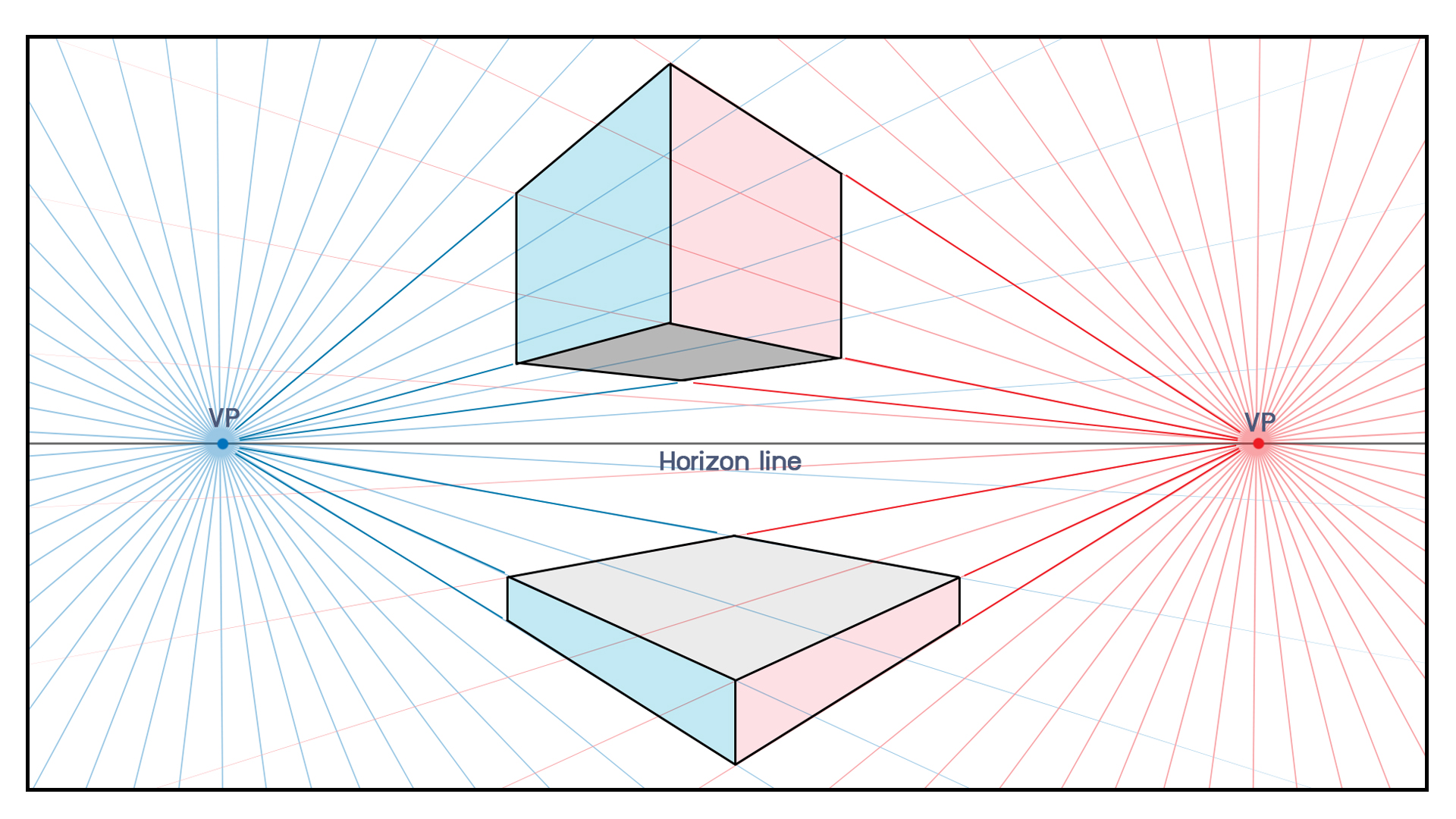
Perspective
The technique of perspective drawing has been a natural form
of expression in various fields such as architecture, painting, and others. Its
name, "Perspective" derives from the Latin words meaning "seeing
through" and "by measure." After countless struggles and
challenges, the technique was eventually perfected by Italian ancestors in the
15th century. With its development, perspective drawing is poised for a bright
future.
Throughout history, artists in Ancient Greece and medieval
Europe employed a variety of techniques to convey the sense of proximity and
three-dimensionality in their works.
What is Perspective?
Perspective is a drawing theory that enables artists to
depict three-dimensional objects on paper or other media, as they appear in
space. The rules of perspective are numerous, but they are based on the premise
that a single eye, from a fixed point of view, is observing the subject being
drawn.
The way each object is viewed in relation to other objects determines
the sense of depth, size relationship, and illusion that the artwork is real or
familiar to what we see in reality.
One Point Perspective
When it comes to layout drawing, one point perspective is
the most commonly used technique because it closely mirrors reality. From our
standing or sitting position, everything we see seems to converge to a single
point.
One point perspective is also referred to as 'parallel perspective'
because the object's height and width are parallel to the picture plane, with
its edges appearing to converge towards a vanishing point on the horizon.
The
horizon line represents the camera's position relative to the subject. However,
tilting the camera introduces a new formula where the height is perpendicular
to the horizon, the width is parallel to it, and depth converges to the
vanishing point.
The grid is the starting point for every layout, serving as a
plane where the animator places the action. It is lightly drawn on the page and
should remain visible throughout the drawing process. Additionally, the
vanishing point should be visible in the drawing to ensure constant reference.
However, it is important to avoid making it look like a spider with multiple
grid lines emanating from it by keeping the grid light at all times.